

How to Anchor Concrete Fasteners to a Block Wall
Published by Robert Carlisle on Mar 30th 2010
Purchase Anchors
In many construction applications, concrete anchors must be fastened to a concrete block to hold a fixture or item of some kind. When installing these concrete anchors, special care must be taken to ensure safe and proper fastening. When fastening to concrete blocks, a number of specific considerations must be taken into account. These include what part of the block to drill into as well as which type of anchor would work the best for the specific application.
What is a concrete block?
A concrete block, cement block, foundation block or concrete masonry unit (CMU), is a large rectangular block used primarily in the construction of walls. Concrete blocks are made from precast concrete, i.e. Portland cement, water, and aggregate. The aggregate used for high-density blocks is usually sand and/or fine gravel. Lower density blocks, more commonly known as cinder blocks, may be produced using cinders as aggregate. These blocks are then layered and stacked vertically to form a wall and are held together using concrete mortar.
Determine where in the block the anchor should be placed
Before choosing the correct anchor for an application, it is necessary to consider where in the block the fastener should be positioned. Will the fastener be placed in (a) the mortar joint, (b) the solid section of the block or (c) the hollow section of the concrete block? Some applications may allow each fastener to be placed in the same part of the block while other installations require that each anchor is placed in different sections of the block.
Tech Tip:
All anchors except for concrete screws exert an outward force. An anchor exerting this pressure against an unsupported edge decreases the anchor’s holding values.
Each section has unique advantages and disadvantages. Fastening into the mortar joint can be an excellent option depending on the quality and quantity of the mortar used to set the block in place. The solid sections of the block usually offer the best quality fastening. This will depend on the distance of the fastener to the unsupported edge of the cavity and the quality of the material from which the block is made. The hollow section of the block is the least desirable section of the block in which to fasten but sometimes can not be avoided. When fastening into the hollow section of a block, there are a few considerations to keep in mind:
(1) When drilling into the block with a hammer drill, the block will spall. This leads to a cone shaped space, with the point of the cone closest to the surface of the block.
(2) When inserting an anchor into this area, whether it's a fastener that exerts pressure or a concrete screw that taps threads into the base material, the holding values will be diminished or become non-existent.
(3) The fastener must not penetrate the wall into the cavity itself.
Determine the type of load being fastened to
The next step in the process is to ascertain the type of load that is going to be anchored. Tech Tip:
Vibratory load:An application that has constant movement. Example: a sign posted on a block wall outside in the wind.
Shock load:An application where a load will be added and taken away. Example: a dock bumper where a truck will back up to the dock and hit the bumper.There are three questions that will help determine the type of load each application produces:
(1) How heavy is the item that is being fastened to the block wall?
(2) Will the load be a vibratory load?
(3) Is the load going to be placed where a shock load could occur?
Determine the type of anchor required
Lastly, the type of fastener required for the application must be determined. There are four options available that can be used in concrete block:
(1) Stud-type anchor: where the stud will stick out from the wall. Example: Sleeve Anchor
(2) Hammer-type anchor: where the stud does not protrude from the wall, for a finished look. Example: Hammer Drive, Nylon Nail-It
(3) Female-type anchor: where a screw is inserted into the anchor for a finished look. Example: Machine Screw Anchor, Lag Shield Anchor, Single Expansion Anchor, Double Expansion Anchor, Leadwood Screw Anchor
(4) Concrete screw: screwed directly into the block for a finished look
If using a stud-type anchor, female type anchor, or the concrete screw- the fixture, or item being fastened, can be removed at any time with little or no damage to the concrete block. However, hammer-type anchors are permanent installations. Removing these fasteners will greatly damage the concrete block and possibly the fixture as well.
Anchor types that can be used in concrete block applications
Stud-Type Anchor - Fixture will be removable
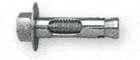 Sleeve anchors come in the widest variety of sizes for applications that fall into this category. Anchors with diameters ranging from 1/4" to 5/16" are sufficient for most light duty applications while the 3/8" and 1/2" diameters are adequate for most medium duty situations. Sleeve anchors with diameters of 5/8" and 3/4" are usually considered heavy duty anchors. An engineer should be consulted every time concrete anchors are used for heavy loads. This anchor is very versatile because there is a wide range of lengths available allowing materials of many different thicknesses to be attached to a block wall. The sleeve anchor also comes in a variety of head styles - hex head, flat countersunk and acorn or round head for aesthetics.
Hammer-type Anchor - Fixture will be non-removable
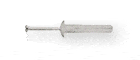 The hammer drive and nylon nail-it anchors are two fasteners that fall into the hammer type category. Neither of these anchors results in a stud protruding from the wall. Both of these anchors are basically non-removable. They are simple to use but should only be used in light duty applications because the only diameter available is 1/4". The hammer drive anchor is produced with a low profile, mushroom head while the nylon nail-it anchor is available in three head styles - mushroom, round and flat countersunk.
Female-type Anchor - Fixture will be removable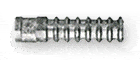
There are a number of different female type anchors. The anchor chosen will depend on the type of bolt being inserted into the anchor as well as the quality of the base material. The sizes of these anchors are designated by the inside diameter of the anchor, which is the size of the bolt that will be inserted into it. The different female type anchors and their unique characteristics are listed below:
The machine screw anchor requires a machine threaded bolt with national coarse threads. For example, 1/4"-20 machine screws require a 1/4" bolt with 20 threads per inch. This anchor also needs to be set in the base material using an appropriately sized setting tool. The 1/4" and 5/16" machine screw anchors should be considered for light duty applications and the 3/8" and 1/2" for medium duty. The 5/8" and 3/4" diameter machine screws are typically reserved for heavy duty use.
Lag shield anchors require the use of a lag screw. Lag shield anchors are available in short and long lengths. The length of the lag shield is generally determined by the quality of the base material. The long lag shield is usually used when the quality of the base material is suspect. The extra length of the long lag shield increases its ability to perform properly. The 1/4" and 5/16" lag shield anchors can be used in light duty applications, the 3/8" and 1/2" for medium duty and 5/8" and 3/4" for heavy duty.
The single expansion anchor and double expansion anchor require the use of a machine threaded fastener with national coarse threading. Both anchors work well in most base materials. The double expansion anchor should be used in applications with questionable base material quality. Both the single and double expansion anchors come in a variety of diameters to allow for usage in many different applications. The 1/4" and 5/16" should be used for light duty type loads, the 3/8" and 1/2" for medium loads and the 5/8" and 3/4" for heavier loading applications.
Leadwood screw anchors were originally made from lead. These concrete anchors are now produced from a material called Zamac - a softer, non-corrosive metal. This fastener is used in light duty applications since it is only available up to 5/16" in diameter. The leadwood screw anchor requires the use of a sheet metal screw. Like sheet metal screws, these anchors are also designated by the gauge wire used to produce the screw - #6, #8 and so on. Different lengths are available in each diameter and can be used in applications with many embedment requirements.
Concrete Screw- Fixture will be removable
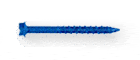 Concrete screws are designed to tap threads into base materials made of concrete, brick or block. They work well in mortar joints as well as in the solid and hollow sections of a block for light duty loads. They are available in a wide array of lengths in both 3/16" and 1/4" diameters. Two different head styles are available - hex head and flat Phillips for countersinking.
All of the fasteners described above are suitable for use in the concrete block- whether it be the solid section of the block, the hollow section or the mortar joint. These fasteners may be used in light or medium load applications with a non-vibratory, non-shock load.
Although some of the fasteners listed above may be appropriate for heavy duty loads, it is not recommended to fasten a heavy load to concrete block. The strength and integrity of the block will be limiting and will most likely fail with a load that is too heavy. Heavy duty, non-vibratory, non-shock loads would require a through-bolted fastening technique or a concrete epoxy type fastener. Vibratory and shock loads would also require a through-bolted fastening system, a concrete epoxy type anchor or a cast-in-place fastener. An engineer should always be consulted if your application requires any of these fastening techniques.
Additional Information
Many construction projects and applications will require fastening to concrete block. Before getting started, it is essential to choose the correct type of concrete anchor as well as determine in what part of the block to fasten the load. Taking the time to make the right decisions will ensure safe and effective anchoring. There are anchors available for use in a wide range of applications. Load type will also be a determining factor during the installation of concrete anchors. With the right knowledge, research and a bit of patience, anchoring concrete fasteners to block can be a simple process.
Purchase Anchors
In many construction applications, concrete anchors must be fastened to a concrete block to hold a fixture or item of some kind. When installing these concrete anchors, special care must be taken to ensure safe and proper fastening. When fastening to concrete blocks, a number of specific considerations must be taken into account. These include what part of the block to drill into as well as which type of anchor would work the best for the specific application.