
Items in Cart:
0
Total:
$0.00
view my cart

Anchoring to Concrete, Brick or Block

Same Day Shipment, Satisfaction Guaranteed | 1.800.966.9617
*We pay the freight on all orders over $1000.00*

Choosing the right concrete anchor for your project means considering specifics including the type of load you are securing and the characteristics of base material you are securing into.


Things to consider:

What are the characteristics of the base material?

Factors include:

  1. Hollow or Solid Core
  2. Density and Strength of the Base Material
  3. Thickness of the Base Material
Hollow Core - drywall, plaster board. sheet rock, particle board, wafer board, plywood, plaster and lath, tile, glass, metal, fiber-glass, plastic and concrete block.

Anchoring to Drywall: A low density material formed between sheets of paper and used primarily for covering studded walls and ceilings. Exhibits relatively low pull-out resistance.

Drywall

Anchoring to Plaster and Lath: Thin wooden strips (lath) were nailed to the studs or ceiling beams and low density plaster was applied over them. Exhibits relatively good pull-out resistance.

Anchoring to Plaster and Lath

Anchoring to Hollow Core Concrete Block: Commonly used in basements and commercial properties. Exhibits relatively high pull-out depending on compression strength of the block.

Anchoring to Hollow Core Concrete Block:
Solid Core: concrete, brick and mortar, stone, solid cinder block and wood.

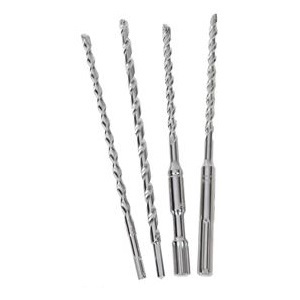
Anchoring to Solid Concrete: Exhibits the highest pull-out resistance, but requires a suitable carbide bit that meets ANSI standards.

Solid Concrete:

Anchoring to Stone: Since there are a large variety and different types, first identify the hardness and characteristics. Then match them up with the type of anchor needed.

Stone

Anchoring to Brick or Mortar: Like stone, brick and mortar range from hard (brittle) to soft. In hard brick anchors with low-impact and/or low-torque are recommended. In soft brick,  a draw-up anchor, i.e. sleeve anchor or machine screw anchor, is recommended.

Brick and Mortar

What is the density of the base material?

There are three degrees of density and strength of base materials:

  • Low Density - weak resistance to stress, i.e. drywall and cinder block.
  • Medium Density - moderate resistance to stress, i.e. plaster, tile fiber board and particle board.
  • High Density - significant resistance i.e. concrete, concrete block, stone..
Resistance to stress will vary within density and thickness of the base material. Age and manufacturing standards for material will result in different failure points for each anchor.

What is the thickness of base material?
Measuring the thickness of the base material will help you to determine the length of the anchor needed for your project.

NOTE: For Hollow Core base material it is critical to have the right length anchor so as to be able to secure tightly. For Solid Core base material the embedment of anchor can not be closer than five (5) anchor diameters, because its an unsupported edge and holding values will be effected.


What type of fixture will you be fastening?
Factors include:

  1. Weight and Size of the Fixture
  2. Location of the Fixture
  3. Stresses Applied to the Fixture

What is the size and weight of the fixture to be fastened?

Size and weight of the fixture are critical to determining not only the type of anchor needed, but also how many anchors are needed per application.

Example: If a fixture weighting 100 pounds needs to be fastened/anchored and the safe working load of the anchor selected is 50 pounds, at least 2 anchors will be needed to safely secure the fixture. Additional anchors may be warranted; not because of weight, but because of the bulkiness or size of fixture. When in doubt, always use more anchors.


What is the location of the fixture to be fastened?

Location plays a big role in selecting the appropriate anchor.

Things to consider:

  • Will the fixture be outside and subjected to the elements or inside? 
  • Will it be on a wall, suspended from a ceiling or fastened to a floor?
  • Will the fixture be close to an unsupported edge?

What kind of stresses may be imposed on the fixture once it is fastened?

Anchors are built differently, depending on the type of load they are meant to secure. The following stresses may be exerting on your fixture – and are critical factors in selecting the right anchor.

Will your fixture be exposed to:

TENSION:

Where a force acts in line with a Fastener, tending to pull it out. Ceiling mounted fasteners, as shown are subjected to tension. But so sometimes are fasteners that are mounted on walls and floors

Tension
SHEAR:

Where a force acts at right angles to a fastener, tending to shear it off. Wall mounted fasteners, as shown are subjected to shear stress. But so sometimes are fasteners that are mounted on ceilings and floors.

Shear
IMPACT:

Occasional or repetitive impacts subject fasteners to stress over and above that resulting from normal tension and shear forces. The railing at right would undergo such impact loads.

Impact
VIBRATION:

Over time vibration will stress fasteners and the base material; Vibration stress can be induced by near by heavy machinery, railroad, automobiles or truck traffic and wind.

Vibration
COMBINATION:

In some cases, fasteners are subjected to two or more of the forgoing stresses. The example at the right fasteners supporting drapery rods. The fasteners are in both tension and shear as well as vibration and shock stress.

Combination

Now that you have familiarized yourself with your project, you can select the appropriate anchor for your job. A complete list of links for available concrete anchors and fasteners can be found below.

  1. Mechanical Fasteners: Best for hollow core materials. Mechanical fasteners open on the back side providing the greatest holding power for hollow wall applications such as drywall, plaster and lath, and hollow core concrete blocks.

    Toggler Bolt, Toggler, Hollow Wall Anchor

  2. Expansion Anchors:  For solid core material.

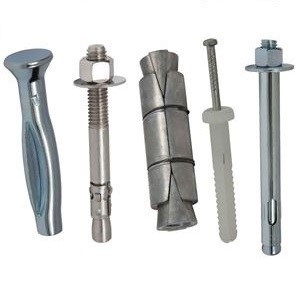
    Expansion anchors produce a friction hold when expanded or wedge inside a hole. Their holding power is enhanced in concrete because the concrete will not “give” like drywall or plaster. Typically employed in solid-core materials-- concrete, brick and mortar, stone, solid cinder block. Heavy to light duty.

Available Concrete Anchors
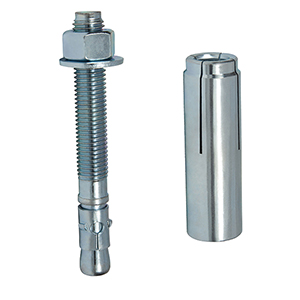
Wedge Anchor Leadwood Screw Anchor Nylon Nail-It Anchor
Sleeve Anchor Single Expansion Anchor Metal Hit Anchor
Drop-In Anchor Double Expansion Anchor Split Drive Anchor
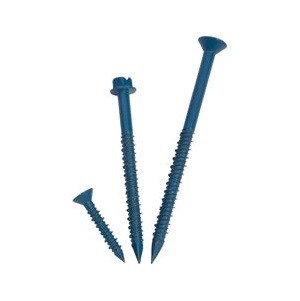
Machine Screw Anchor Lag Shield Anchor Tapcon Screw

NOTE: The distance between anchors is critical. If installed to close to each other, the interaction of forces between fasteners will reduce the holding power of the anchor in the base material. As a general rule, the anchor & fastener industry has established the following minimum spacing standards: Ten (10) anchor diameters between anchors, five (5) anchor diameters from the edge.